
Amotus designs the embedded electronics, safety-aware firmware, and connected-vehicle cloud behind rolling stock, commercial fleets, and special-purpose vehicles. We engineer to ISO 26262 (automotive functional safety), the EN 5012x rail standards, and ISO/SAE 21434 vehicle cybersecurity, and we deliver work products that slot into your safety case. Bilingual engineering team headquartered in Quebec City.
- 13+ years of embedded electronics & firmware engineering
- ISO 26262 ASIL-aware development (A–D)
- EN 50155 · EN 50121 rail electronics experience
- EN / FR Quebec-based team
Book a FREE 30-min qualification call — response within 48 h →
Who we build transportation electronics for
Rail and transit equipment manufacturers
You build rolling stock, signalling, or on-board systems and need electronics that survive the rail environment and document to EN 50155 (equipment), EN 50121 (EMC), and the EN 50128 / EN 50129 safety standards. We design hardware and firmware with the traceability and verification records your safety assessor expects.
Commercial fleet and off-highway OEMs
You build trucks, buses, agricultural or construction vehicles and want them connected — telematics, remote diagnostics, usage-based maintenance, secure OTA. We design the rugged electronics, the firmware, and the cloud fleet layer, with functional-safety rigour where it's needed (ISO 26262 ASIL).
Mobility and connected-vehicle innovators
You're adding telematics, an HMI, or a connected service to a vehicle platform. We build the embedded HMI (Automotive Grade Linux, QNX), the secure connectivity, and the back-end, while respecting UNECE R155 (cybersecurity) and R156 (software update management).
Standards and frameworks we work to
| Standard | Scope |
|---|---|
| ISO 26262 | Road-vehicle functional safety (ASIL A to D) |
| ISO/SAE 21434 | Road-vehicle cybersecurity engineering |
| UNECE R155 / R156 | Cybersecurity & software update management systems |
| AUTOSAR (Classic & Adaptive) | Automotive software architecture |
| EN 50155 | Electronic equipment for rolling stock |
| EN 50121 | Railway EMC |
| EN 50128 / EN 50129 | Railway software & safety-related electronic systems (SIL) |
| DO-178C / DO-254 | Airborne software & hardware |
| IEC 61508 | Base functional safety of E/E/PE systems |
Transparency note: Amotus does not hold a corporate IATF 16949 or ISO 26262 certificate, and is not a certification body. We engineer to the requirements of these standards, produce the work products they require (safety plan, hazard analysis, traceability, verification records), and integrate into your organization's safety case and quality system so your assessor or notified body can review them.
Our services for transportation & mobility
Safety-aware embedded electronics
PCBs designed for vibration, shock, wide-temperature, and EMC requirements (EN 50121 for rail, automotive EMC for road), with redundancy and diagnostics where the safety level requires it, and long-term component availability.
Deliverables: schematics, BOM with second-source analysis, EMC compliance file, environmental qualification reports, safety-relevant design documentation.
Functional-safety firmware (ISO 26262 / EN 5012x)
Firmware developed to MISRA C:2012 with bidirectional traceability requirements → code → tests, safety mechanisms (watchdogs, plausibility checks, lockstep where available), and the verification coverage your ASIL or SIL target demands.
Deliverables: software safety requirements, architecture, documented source, V&V plan, coverage report, safety analysis (FMEA / FMEDA inputs).
Fleet telematics & connected-vehicle platforms
Rugged telematics units, GNSS, cellular (LTE-M / 4G / 5G), CAN / CAN-FD / J1939 vehicle-bus integration, and a cloud fleet portal for diagnostics, geofencing, and usage-based service.
Deliverables: telematics hardware/firmware, vehicle-bus integration, fleet back-end, dashboards, API.
Embedded HMI & infotainment
In-vehicle displays and HMI on Automotive Grade Linux or QNX, with a clean separation between safety-relevant and non-safety functions.
Deliverables: HMI software, BSP, integration with vehicle network, performance & boot-time validation.
Vehicle cybersecurity (ISO/SAE 21434, UNECE R155)
Threat analysis and risk assessment (TARA), secure boot, key management, encrypted in-vehicle and cloud communication, and a security case aligned with the R155 cybersecurity management system.
Deliverables: TARA, security concept, SBOM, secure-boot & key-management design, monitoring plan.
Secure OTA for vehicles (UNECE R156 / ISO 24089)
Signed, fail-safe over-the-air update mechanism with rollback, staged rollout, and an auditable software update management process compatible with R156.
Deliverables: OTA protocol, signing infrastructure, update campaign tooling, audit logging.
Our transportation methodology — a safety-lifecycle V-model
- Item definition & hazard analysis — HARA (ISO 26262) or equivalent, determine ASIL / SIL
- Safety & security requirements — functional safety + ISO/SAE 21434 cybersecurity goals
- Architecture & safety concept — allocate safety mechanisms, define the verification strategy
- Implementation with traceability — requirements ↔ code ↔ tests, MISRA compliance
- Verification & validation — unit / integration / HIL, documented coverage, fault-injection where required
- Safety case & production transfer — work products assembled for your assessor, maintenance & OTA plan
The level of rigour scales with the ASIL/SIL: we don't impose Class-D effort on a non-safety dashboard, and we don't under-engineer a braking-adjacent function.
Project example — connected fleet telematics
Project: a rugged, connected telematics and remote-monitoring unit for vehicles in the field, with secure firmware updates and a fleet management back-end — the same hardware-to-cloud pattern behind Amotus connected-product work such as the Tero remote control & monitoring product.
What we engineered:
- Rugged edge electronics with wide-temperature components and vehicle-grade power input
- Firmware integrating the vehicle bus (CAN / J1939) and cellular connectivity
- Secure, signed OTA update mechanism with rollback
- Cloud back-end with fleet management, geofencing, and diagnostics export
Tech stack: STM32 / NXP i.MX · FreeRTOS & Embedded Linux · CAN-FD / J1939 · LTE-M · Fundamentum IoT platform · TLS 1.3
Most of our transportation clients operate under confidentiality agreements, so project details on this site are kept at the technical level. We can discuss relevant, reference-checkable experience under NDA during a qualification call.
Typical tech stack for a transportation project at Amotus
| Layer | Technologies commonly deployed |
|---|---|
| Hardware | STM32H7 · NXP i.MX RT and i.MX 8 · Infineon AURIX (safety) · automotive-grade sensors |
| Embedded OS | FreeRTOS · Zephyr · Automotive Grade Linux · QNX · AUTOSAR (Classic/Adaptive) |
| Languages | C (MISRA C:2012) · C++ · Rust (greenfield) |
| Vehicle buses | CAN · CAN-FD · LIN · J1939 · Automotive Ethernet |
| Connectivity | LTE-M · 4G / 5G · GNSS · BLE 5.3 |
| Cloud | Fundamentum IoT PaaS (multi-region) — interfaces with AWS IoT Core / Azure IoT Hub if required |
| Safety / QA tooling | Polyspace · Coverity · VectorCAST · HIL benches · GitLab CI/CD with documented coverage |
Frequently asked questions — transportation electronics
How do you handle data security?
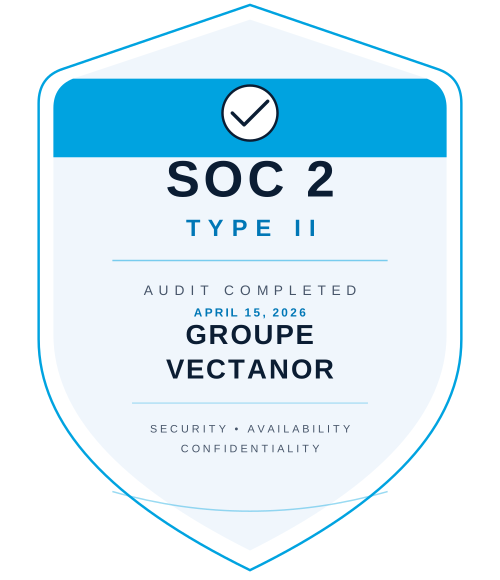
Security is a first-class design requirement, not an afterthought. We work to SOC 2 Type II–audited practices (Groupe Vectanor), with zero-trust architecture, mTLS between devices and cloud, encryption in transit and at rest, and data residency in the region you require on our multi-region Fundamentum platform (Canada, US, Europe, and more). Your data stays yours, with clear ownership and open export.
What are ISO 26262 ASIL levels?
ASIL (Automotive Safety Integrity Level) classifies the risk of a vehicle function from ASIL A (lowest) to ASIL D (highest), with QM (Quality Managed) for functions with no safety relevance. The level is derived from severity, exposure, and controllability of potential hazards, and it drives how much architecture, verification, and documentation the function requires. Classification happens during the hazard analysis (HARA) at the start of the project.
How much does ISO 26262 firmware development cost?
The safety overhead is the key driver. A non-safety connected feature might be a standard embedded project; an ASIL-B function adds significant effort for safety analysis, additional verification, and documentation, and ASIL-D considerably more. Your quote depends on scope and safety level.
What does EN 50155 mean for my rail project?
EN 50155 is the core standard for electronic equipment used on rolling stock. It covers environmental conditions (temperature, vibration, shock, humidity), power-supply behaviour, EMC (with EN 50121), and reliability expectations. Designing to EN 50155 from the start avoids costly redesigns when your equipment goes through type testing.
Do you handle the full ISO 26262 or rail safety certification?
We are not a certification or assessment body. The independent assessment and homologation are performed by your safety assessor or a notified body. What we deliver is the full set of engineering work products the safety case requires — safety plan, HARA inputs, safety requirements, architecture, V&V records, traceability — structured so your assessor can review them efficiently.
AUTOSAR Classic or Adaptive — which do I need?
Classic AUTOSAR targets deeply embedded, real-time ECUs (microcontrollers, hard real-time, safety). Adaptive AUTOSAR targets high-performance compute (microprocessors, POSIX, service-oriented architecture) for connected and automated functions. Many modern vehicles use both. We help you decide based on the ECU's role, compute needs, and safety level.
How do you secure OTA updates for vehicles (UNECE R156)?
We use cryptographically signed updates, fail-safe rollback, and staged rollout, wrapped in a documented software update management process aligned with UNECE R156 and ISO 24089. Every update is auditable, which is exactly what the regulation and your type-approval require.
Can you work on rail, automotive, and off-highway?
Yes. The underlying functional-safety discipline (IEC 61508) is shared across domains; the domain-specific standards differ (ISO 26262 for road, EN 5012x for rail, DO-178C/DO-254 for airborne). We adapt the work products and verification strategy to your domain's standard and your assessor's expectations.
What is the typical duration of a transportation project?
A connected telematics unit is typically 6 to 12 months. A safety-relevant firmware module (ASIL-B/C, with the associated V&V and safety case) often runs 12 to 24 months. Rail equipment with full type testing depends heavily on the test campaign schedule. We scope this precisely after the hazard analysis.
Why Amotus for your transportation project
- Full-stack hardware-to-cloud — electronics, firmware, connectivity, and cloud under one roof, so safety and security traceability is maintained across layers
- Functional-safety fluent — ISO 26262, EN 5012x, IEC 61508 work products that integrate into your safety case
- Right-sized rigour — effort scales with the ASIL/SIL; we don't over- or under-engineer
- Bilingual EN / FR — Quebec-based team serving North American and European transportation clients
- Fundamentum IoT platform — our Canadian IoT PaaS can accelerate the connected-vehicle cloud and fleet layer
Book a FREE 30-min qualification call — response within 48 h →