Amotus designs the wireless connectivity of IoT products — short-range (BLE 5.3, Matter, Thread, Wi-Fi 6, UWB, NFC) and wide-area (LoRaWAN, Cellular, LTE-M, 5G, satellite) — choosing the right protocol for range, power, and cost, then implementing it to interoperate and certify. Bilingual engineering team headquartered in Quebec City.
- 13+ years of wireless & connectivity engineering
- BLE · Matter · Thread · Wi-Fi · UWB short-range
- LoRaWAN · Cellular (LTE-M) · 5G · satellite wide-area
- EN / FR Quebec-based team
Book a FREE 30-min qualification call — response within 48 h →
When you need a connectivity partner
You're choosing a wireless protocol
The connectivity choice shapes your whole product — battery life, range, cost, cloud, certification. We help you choose correctly the first time with a clear decision framework, not a vendor's default.
You're adding smart-home interoperability (Matter/Thread)
You want your product to work in Apple Home, Google Home, and Alexa. We design Matter over Thread or Wi-Fi, the commissioning UX, and the path to Matter certification.
You need connectivity where it's hard
Long range, deep indoor, rural, or mobile. We combine LPWAN, cellular, and satellite with local buffering so your device stays connected — or degrades gracefully — wherever it lives.
Protocols & standards we work with
| Protocol | Best for |
|---|---|
| Bluetooth LE 5.3 | Short-range, low-power, phone-connected devices |
| Matter | Smart-home interoperability across ecosystems |
| Thread | Low-power IP mesh (often under Matter) |
| Wi-Fi 6 | High-bandwidth, mains-powered devices |
| UWB | Precise ranging & location |
| LoRaWAN | Long range, very low power, private networks |
| Cellular (LTE-M) | Cellular LPWAN with carrier coverage |
| 5G | High-throughput, low-latency, massive density |
| Satellite (NTN) | Truly remote / no-terrestrial-coverage sites |
| NFC · Zigbee | Tap-to-pair, legacy mesh |
Transparency note: protocol certifications (Bluetooth SIG, Matter/CSA, Wi-Fi Alliance, LoRa Alliance) and regulatory approvals (FCC/ISED/CE) are granted by those bodies and accredited labs. We design and pre-test for them and manage the campaign; we don't issue the certificates.
Our connectivity services
Protocol selection & architecture
A structured trade-off across range, power, bandwidth, cost, topology, and certification, ending in a clear recommendation and a connectivity architecture.
Deliverables: decision matrix, connectivity architecture, power/range budget, certification path.
Matter & Thread development
Matter over Thread or Wi-Fi, device commissioning, ecosystem testing (Apple/Google/Amazon/SmartThings), and Matter certification readiness.
Deliverables: Matter/Thread firmware, commissioning flow, ecosystem test results, certification readiness.
BLE & short-range
BLE 5.3 design (GATT services, connection/power tuning, mobile pairing), plus UWB ranging and NFC where they fit.
Deliverables: BLE firmware & profiles, mobile integration, power tuning, range validation.
LPWAN & cellular
LoRaWAN (incl. private network design with ChirpStack/TTN), Cellular (LTE-M), 5G, and satellite — connectivity that survives real coverage conditions.
Deliverables: LPWAN/cellular firmware, network design, coverage strategy, buffering/QoS logic.
Antenna & RF, certification readiness
Antenna selection and tuning, RF layout discipline, pre-scan testing, and management of certification with accredited labs (modular vs. full).
Deliverables: antenna design, pre-scan results, certification plan, lab coordination.
Interoperability & field testing
Real-world testing across phones, gateways, ecosystems, and coverage conditions, so connectivity works outside the lab.
Deliverables: interop test plan & results, field-coverage report, issue log & fixes.
Our connectivity methodology
- Requirements — range, power, bandwidth, mobility, cost, ecosystems, certification
- Protocol decision — structured trade-off → recommendation
- Design & implementation — firmware, antenna/RF, network
- Pre-compliance & interop — RF pre-scans, ecosystem and field testing
- Certification — protocol + regulatory campaigns with accredited labs
- Validate in the field — real coverage, real devices
Project example — multi-protocol connected device
Project: a connected product needing both local control and cloud reach — BLE for the phone, an LPWAN or cellular path to the cloud — with clean handoff and field-proven reliability, the connectivity layer of Amotus's hardware-to-cloud builds.
What we engineered:
- BLE 5.3 for mobile pairing and local control
- LoRaWAN / Cellular path to the cloud with local buffering
- Antenna tuning and FCC/ISED/CE pre-compliance
- Interoperability and field-coverage validation
Tech stack: Nordic nRF52/nRF53 · ESP32 · BLE 5.3 · Matter/Thread · LoRaWAN · Cellular · MQTT over TLS
Most of our clients operate under confidentiality agreements, so project details on this site are kept at the technical level. We can discuss relevant, reference-checkable experience under NDA during a qualification call.
Typical connectivity tech stack at Amotus
| Layer | Technologies commonly deployed |
|---|---|
| Wireless SoC | Nordic nRF52/nRF53/nRF91 · Silicon Labs (Matter/Thread) · ESP32 · Quectel/u-blox (cellular) |
| Short-range | BLE 5.3 · Matter · Thread · Wi-Fi 6 · UWB · NFC · Zigbee |
| Wide-area | LoRaWAN · Wi-SUN · DigiMesh · Wirepas · Cellular (LTE-M) · 5G · satellite (NTN) |
| Network servers | ChirpStack · The Things Network · carrier platforms |
| App protocols | MQTT · CoAP · over TLS/DTLS |
| Certification | Bluetooth SIG · Matter (CSA) · Wi-Fi Alliance · LoRa Alliance · FCC/ISED/CE |
Frequently asked questions — connectivity
How do you handle data security?
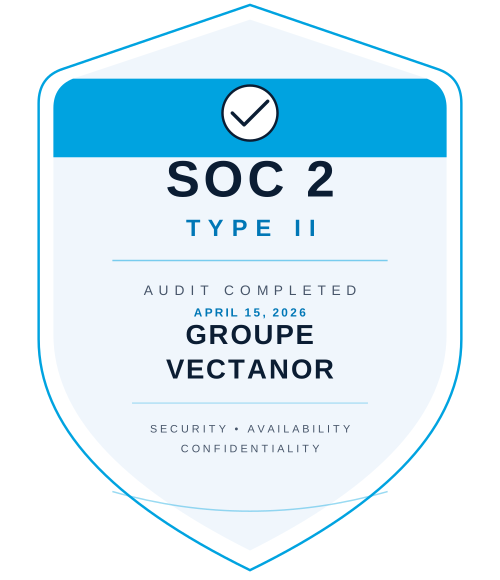
Security is a first-class design requirement, not an afterthought. We work to SOC 2 Type II–audited practices (Groupe Vectanor), with zero-trust architecture, mTLS between devices and cloud, encryption in transit and at rest, and data residency in the region you require on our multi-region Fundamentum platform (Canada, US, Europe, and more). Your data stays yours, with clear ownership and open export.
LoRaWAN, Cellular, or LTE-M — how do I choose?
LoRaWAN: longest range and battery life, unlicensed, you can own the network — best for high counts of low-data sensors where you control gateways. Cellular: carrier-based, great for stationary low-data devices, deep indoor. LTE-M: carrier-based, supports mobility and higher data/lower latency than Cellular. The decision turns on data rate, mobility, who owns the network, and battery target. We map it to your case.
Should I use Matter and Thread?
If your product is a smart-home device, Matter lets it work across Apple, Google, and Amazon without three separate integrations, and Thread gives it a robust low-power IP mesh. The cost is certification effort and a maturing spec. For non-smart-home or simple phone-connected products, BLE alone is often the better, cheaper choice. We design for the one that actually fits.
What about 5G for IoT?
5G matters when you need high throughput, very low latency, or massive device density (video, AR, dense industrial). For most sensor IoT, LPWAN or LTE-M is more power- and cost-appropriate. We use 5G where its strengths are required, not as a buzzword.
How do you handle areas with poor or no coverage?
We combine technologies — LoRaWAN or your own gateway for local coverage, cellular where it exists, satellite (non-terrestrial networks) for truly remote sites — and design store-and-forward buffering so data isn't lost when the link drops. A site survey drives the mix.
Can you get my device through wireless certification?
We design for it (antenna tuning, RF layout, pre-scans) and manage the campaign with accredited labs, covering both protocol certification (Bluetooth SIG, Matter, etc.) and regulatory approval (FCC/ISED/CE). Pre-certified modules can cut cost and time; we advise on the trade-off.
How much does the connectivity portion of a project cost?
It depends on the protocols and the certification scope. A single well-supported protocol (e.g. BLE) is the simplest case; multi-protocol designs or Matter/Thread with certification take more effort, and certification lab fees are separate, per regime. Your quote depends on protocols and certification scope.
Why Amotus for your connectivity
- Full-stack hardware-to-cloud — connectivity designed with the antenna, firmware, and cloud together
- Protocol-neutral — we recommend what fits, from BLE to satellite
- Matter/Thread ready — current smart-home interoperability, not legacy-only
- Field-proven — we validate in real coverage, not just the lab
- Bilingual EN / FR — Quebec-based team
Book a FREE 30-min qualification call — response within 48 h →